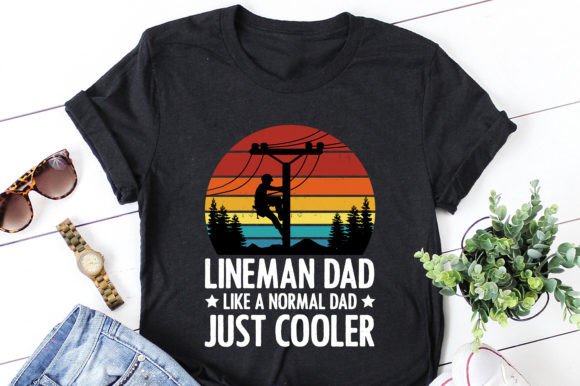
Lineman Dad: A Designer’s Take on Embroidery Use
As a designer who spends half my life staring at stitch maps and the other half troubleshooting thread breaks, I have learned to look past the flashy marketing of digital files. When I first pulled up Lineman Dad Like a Normal Dad, my immediate reaction was not about the humor, but about the structural integrity of the design for actual needlework. We see countless novelty graphics flooding the market, but few are vetted for how they translate from a screen to a textured fabric surface. This review is for the embroidery designers, Etsy sellers, and craft business owners who need to know if this asset holds up under the needle.
First Impressions and Visual Personality
The mood of Lineman Dad Like a Normal Dad is playful yet rugged, striking a balance that appeals to a specific demographic of blue-collar pride mixed with parental warmth. Visually, the layout relies on bold typography and iconic imagery associated with electrical work. For an embroidery project, this is promising. Bold lines generally translate better to stitching than intricate, wispy details that can get lost in fabric texture. The design exudes a sense of reliability and coolness, which makes it a strong candidate for personalized gifts where the recipient wants to feel seen and appreciated for their hard work.
However, as a reviewer, I must note that the product description lists this primarily as a T-Shirt Design in PNG and EPS formats. This is a crucial distinction. If you are planning to use this as a direct-to-garment print, the 4500px by 5400px resolution at 300 DPI is excellent. But for those of us looking to create a machine embroidery design, we face a different set of challenges. You cannot simply feed a PNG into an embroidery machine. This graphic serves as a foundational design asset that requires digitization or careful adaptation if you intend to stitch it.
Real-World Application: The Sweatshirt Test
Let’s walk through a real-life scenario. Imagine a customer approaches your small shop requesting a custom gift for their father, a lineman who rarely treats himself. They want something durable, not just a printed tee that fades after three washes. You decide to adapt the Lineman Dad Like a Normal Dad concept into a sweatshirt embroidery piece.
In this context, the bold nature of the graphic works in your favor. On a heavy cotton blend sweatshirt, a well-digitized version of this design would stand out beautifully. The "cooler" aspect mentioned in the description suggests a modern, clean aesthetic. If you convert this into an applique design, you could use contrasting fabrics for the text or icons, reducing stitch count while adding tactile depth. This approach minimizes the risk of the fabric puckering, a common issue with dense fill stitches on thick garments.
Alternatively, if you are selling printed mockups or using the PNG for sublimation on polyester blends, the transparent background provided in the file is a significant time-saver. It allows you to place the graphic seamlessly onto various custom apparel items without tedious photo editing. For an Etsy seller, having both the vector EPS for scaling and the high-res PNG for previews creates a versatile workflow.
Navigating Fabric and Hoop Constraints
While the design is visually strong, its application requires careful consideration of materials. If you attempt to stitch a complex version of this design on a cap or curved surface, you must be wary of distortion. Curved surfaces demand lower stitch density and careful pull compensation. A design that looks flat and perfect on a screen can warp significantly on a baseball cap if the stitch density is too high.
For tote bag designs or canvas materials, the sturdy nature of the linen dad theme fits perfectly. However, canvas has a loose weave. Without a proper stabilizer, fine details might sink into the fabric. I recommend using a cut-away stabilizer for any garment that will undergo frequent washing, such as work shirts or aprons. For decorative items like pillow covers or kitchen towels, a tear-away stabilizer might suffice, but always test on scrap fabric first.
Be cautious with tiny lettering. If the digitized version of "Like a Normal Dad" features small serif fonts or tight kerning, these areas are prone to thread breaks and poor readability. In embroidery, less is often more. Ensure that any running stitch outlines are secure and that fill stitch areas do not overlap excessively, which can cause bulkiness and discomfort for the wearer.
Commercial Viability and Brand Consistency
For commercial embroidery professionals, the value of a design lies in its versatility and customer appeal. Lineman Dad Like a Normal Dad taps into a niche market that values identity and profession. This specificity can drive higher engagement and sales for small shop products because it feels personal rather than generic. When customers see a design that speaks directly to their unique role, they are more likely to perceive the finished product as high-value.
Using this graphic in your portfolio or as a base for embroidered patches can enhance your brand’s reputation for thoughtful, targeted designs. Patches are particularly forgiving for complex graphics because they are stitched on stable backing before being applied to the garment. This allows for higher detail and denser stitching without worrying about garment distortion.
However, transparency in licensing is key. Since the provided files are PNG and EPS, ensure you have the right to use these graphics for commercial digitization. Some designers sell the graphic for print-only use, while others allow derivative works for embroidery. Always verify the license terms before selling digital embroidery files or finished goods derived from this artwork.
Practical Notes for the Embroiderer
Before committing to a full production run, take these practical steps:
- Test on Scrap Fabric: Always stitch a sample on the same material you plan to use for the final product. Check for puckering, thread breaks, and registration issues.
- Check Thread Contrast: The design’s impact relies on visibility. Ensure your thread colors contrast sufficiently with the fabric. A dark thread on a dark shirt will vanish, ruining the effect.
- Review Stitch Density: If you are digitizing this from the EPS file, keep stitch density moderate. High density leads to stiffness and potential fabric damage.
- Confirm Hoop Size: Ensure the design fits within your standard hoop sizes. If it is too large, consider splitting it or resizing, keeping in mind that resizing affects stitch quality.
- Mockup Verification: Use the included T-shirt mockup to visualize the placement, but remember that printed mockups do not show texture. Create a physical sample to judge the true tactile quality.
In conclusion, Lineman Dad Like a Normal Dad is a compelling graphic with strong potential for both print and embroidery applications. Its success in a craft business setting depends on how well you adapt it to the medium. For printers, it is ready to go. For embroiderers, it is a challenge worth taking, provided you respect the technical limitations of the needle and thread. By focusing on fabric choice, stabilizer support, and smart digitization, you can turn this graphic into a standout personalized gift or a best-selling item in your handmade product lineup.