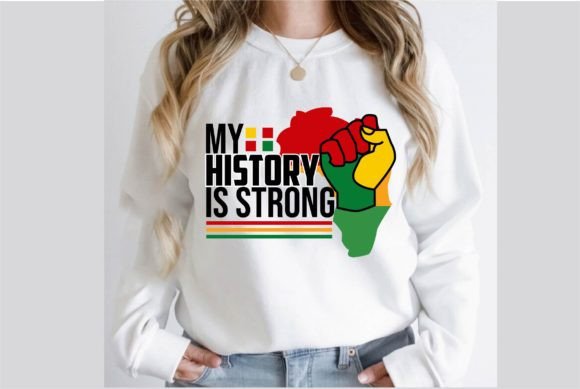
Review: My History is Strong T-Shirt Design for Embroidery
As a designer who spends more time staring at stitch maps than most people spend watching television, I approach every new digital embroidery file with a healthy dose of skepticism. We have all been there: you buy a beautiful graphic, convert it, and end up with a puckered mess or a design that loses its soul under the needle. That is why I took a close look at the My History is Strong T-Shirt Design before committing it to any client projects. This isn't just about whether the image looks good on a screen; it is about how it translates into thread, fabric, and ultimately, a handmade product that holds up in the real world.
My first impression of this asset was its bold, declarative nature. The typography carries a weight that suggests resilience and pride, which immediately made me think of specific applications beyond the standard cotton tee. While the product title categorizes it under T-Shirt Designs and Graphics, my mind went straight to heavy-weight fabrics. I envisioned this stitched onto a structured canvas tote bag design or the chest of a fleece-lined hoodie. The visual personality of the piece feels grounded and serious, making it an excellent candidate for custom apparel meant to make a statement rather than just decorate.
Real-World Application: The Boutique Sweatshirt Test
To truly evaluate the potential of this design, I ran a mental simulation of a recent request I received for a small batch of sweatshirt embroidery for a local community group. They wanted something that felt personal but professional. The My History is Strong T-Shirt Design fits this brief perfectly. When imagining this on a heather grey French terry cloth, the contrast of the text against the textured background creates a sophisticated look. It avoids the trap of looking like a cheap iron-on transfer because the inherent nature of embroidery adds depth.
For an Etsy seller or small shop product creator, this kind of versatility is gold. You aren't limited to one niche. This design could easily pivot from a empowering message on a women's tank top to a commemorative holiday embroidery gift for a family reunion. The layout is clean enough that it doesn't overwhelm smaller garments, yet it has enough presence to stand out on a larger finished product like a blanket or wall hanging. If you are building a brand around empowerment or heritage, this graphic serves as a strong foundational design asset.
Navigating Fabric Choices and Stitch Density
However, enthusiasm must be tempered with technical reality. One of the critical factors when using any pre-made graphic for embroidery is understanding how it interacts with different materials. Since this package includes high-resolution formats like PNG (4500×5400 at 300 dpi), SVG, EPS, AI, and PDF, you have the flexibility to digitize it yourself or send it to a professional digitizer. This is crucial because the original files are vector and raster graphics, not necessarily pre-digitized machine embroidery design files with defined stitch types.
If you are planning to digitize this for a running stitch outline or a dense fill stitch background, you need to consider the stitch density. On thin fabrics like a lightweight rayon blouse, a heavy fill could cause significant puckering. In those cases, I would recommend adapting the design into an applique design. By using a fabric backing for the letters or shapes, you reduce the thread count while maintaining the boldness of the message. This technique works exceptionally well for embroidered patch creations that can be sewn onto denim jackets or hats later.
Caution is also advised when working with stretchy fabrics or curved surfaces. If you attempt to stitch this directly onto a fitted cap, the curvature might distort the lettering unless your hoop size and stabilizer strategy are on point. Always test the design on scrap fabric first. Check how the thread colors interact with the base material. A dark thread on a dark shirt might look sleek in a mockup but disappear entirely once stitched if the sheen isn't right. Conversely, high-contrast threading can sometimes look too harsh if the font edges aren't smoothed out during the digitizing process.
Enhancing Brand Value and Customer Trust
Beyond the technical stitching, there is the matter of perceived value. In the world of craft business, presentation is everything. Using a cohesive, well-thought-out design like My History is Strong T-Shirt Design elevates the perceived quality of your personalized gift or commercial item. Customers can tell when a design feels intentional. Whether you are selling baby embroidery items for a nursery or creating merchandise for a boutique, consistency builds trust.
This specific design lends itself well to printable mockup creation. Because you receive high-quality JPG and PNG files, you can create stunning previews for your online store without ever stitching a single thread. This allows you to gauge customer interest before committing to production. For commercial embroidery projects, having these various file formats means you can easily adapt the artwork for packaging, social media posts, or even screen printing if a client requests a mixed-media approach.
Final Verdict and Designer Notes
Ultimately, the My History is Strong T-Shirt Design is a robust starting point for a variety of creative entrepreneurs. It bridges the gap between digital art and tactile craftsmanship. However, remember that the included formats (AI, PDF, SVG, JPG, PNG, EPS) are graphics, not stitch files. You will need to digitize them appropriately for your specific machine and hoop constraints. Do not assume a one-size-fits-all approach.
- Check Licensing: Before selling finished items or digital products derived from this, confirm the specific license terms provided with your download.
- Stabilizer Selection: Match your stabilizer to the fabric texture; cut-away is usually best for stretchy knits, while tear-away works for stable wovens.
- Test Runs: Always stitch a sample on similar fabric to check for registration issues, especially with detailed corners or tiny lettering.
- Color Contrast: Review the design in black and white mockups to ensure the shape holds up without relying on color differentiation.
- Hoop Size: Confirm the dimensions fit your available hoops, particularly if you plan to place it on sleeves or pockets.
By treating this graphic as a flexible component rather than a rigid template, you can unlock its full potential. Whether it ends up on a kitchen towel, a tote bag, or a premium jacket, the strength of the message combined with quality execution will resonate with your audience. It is a solid addition to any library of design assets for those who value both aesthetics and durability in their embroidery project workflow.