Count Your Blessings: A Designer's Review
As a designer who spends more time staring at stitch maps than most people spend looking at their phones, I approach every new machine embroidery design with a mix of optimism and skepticism. We have all downloaded files that looked perfect on the screen but turned into a bird's nest of thread breaks and puckering on the hoop. So, when I came across the Coun t Your Blessings Not Your Problems graphic, my first instinct wasn't to rush to the checkout, but to analyze its potential as a finished product. This isn't just about having a pretty image; it is about whether this digital embroidery file can withstand the rigors of real-world application in a craft business or personal project.
First Impressions and Visual Personality
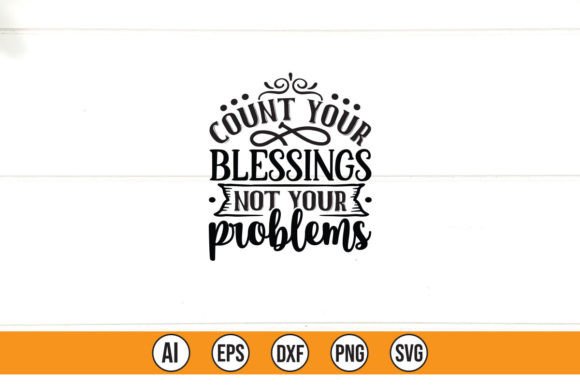
The immediate appeal of Coun t Your Blessings Not Your Problems lies in its sentiment. In a market saturated with generic quotes, this phrase offers a grounding, positive message that resonates well with current trends in home decor and apparel. Visually, the layout appears balanced, suggesting a design that prioritizes readability. For us as creators, readability is king. If a customer has to squint to understand the message on a sweatshirt embroidery project, the design has failed, regardless of how intricate the stitches are.
The fact that this product comes as a suite of Graphics including AI, EPS, SVG, and DXF formats tells me immediately that versatility is a key selling point. As an experienced reviewer, I appreciate having access to vector files like AI and EPS. These allow me to tweak the typography or adjust the spacing before converting it into a stitch file if my digitizing software permits, or simply to use them for high-quality printable mockup presentations for my Etsy shop. The inclusion of 300 DPI PNGs with transparent backgrounds is crucial for creating professional listing images without needing to spend hours removing backgrounds manually.
Real-World Application: The Tote Bag Test
To truly evaluate this design, I imagined a specific scenario: a custom order for a local boutique needing a run of canvas tote bags for a holiday market. Canvas is a forgiving fabric, but it has a distinct texture. When visualizing Coun t Your Blessings Not Your Problems on a natural cotton tote, the contrast between the thread and the fabric becomes the focal point. Because the design is text-heavy, the choice of thread colors will make or break the final look. A deep navy or forest green against a cream canvas would evoke a rustic, handmade feel, while a bright coral or teal could modernize the piece for a younger demographic.
This design fits naturally into the category of T-Shirt Designs as well. Imagine this stitched onto the chest pocket of a denim shirt or centered on a soft tri-blend tee. The message is universal enough for personalized gift giving, perhaps for a teacher appreciation week or a gratitude-themed workshop. The "100 color changeable" feature mentioned in the product details is a massive plus here. It means I am not locked into a specific palette; I can adapt the embroidery file to match a client's brand colors or a specific nursery theme without needing to re-digitize the entire pattern.
Navigating Fabric Challenges and Stitch Density
However, enthusiasm must be tempered with technical reality. Text-based designs can be tricky depending on the font weight and the resulting stitch density. If the letters in Coun t Your Blessings Not Your Problems are too thin, they may require a satin stitch that is prone to snagging. If they are filled, the density might cause puckering on stretchy fabrics like jersey knits. This is where the advice to "test the design on scrap fabric first" becomes non-negotiable.
Before committing to a client's expensive garment, I would always run a test on a similar weight fabric. If you are planning to use this on a baby embroidery project, such as a onesie or a burp cloth, you must be extra cautious. Babies have sensitive skin, and a dense block of stitching can feel scratchy. In these cases, checking if the design works as an applique design could be a smart pivot, using the cut files provided (SVG/DXF) to create a fabric applique rather than a dense stitch fill. This reduces the stiffness of the finished product and adds a charming, textured dimension.
Furthermore, curved surfaces present their own challenges. Placing this design on a cap requires careful consideration of the hoop size and the curvature of the front panel. Long lines of text can distort on a curved surface if not stabilized correctly. Using a sturdy cut-away stabilizer would be my recommendation for caps and frequently washed items like kitchen towels or aprons to ensure the design retains its shape over time.
Commercial Viability and Brand Consistency
For Etsy sellers and small shop owners, the value of a design extends beyond the stitch count. It is about how the design elevates the brand. Coun t Your Blessings Not Your Problems has a wholesome, uplifting vibe that aligns well with brands focusing on wellness, mindfulness, or family-oriented products. Using the included high-quality mockups allows sellers to showcase the design on various products—pillow covers, wall art, or apparel—before even stitching a single thread. This capability speeds up the listing process and helps in gauging customer interest.
When selling commercial embroidery items, consistency is key. If you plan to sell this as part of a series, the ability to edit colors ensures that every item in your collection feels cohesive. Whether you are creating a line of holiday embroidery gifts or everyday wear, the flexibility of the file formats supports a professional workflow. However, it is vital to read the licensing terms included in the instructions. While the files are editable, confirming whether you can sell the digital file itself versus the physical stitched item is a critical step to avoid copyright issues.
Final Verdict for the Practical Maker
In conclusion, Coun t Your Blessings Not Your Problems stands out as a versatile asset for the modern maker. Its strength lies in its adaptability across different mediums, from sturdy tote bag design applications to delicate baby clothes. The comprehensive file package (AI, EPS, SVG, DXF, PNG) provides the necessary tools for both digitizers and those looking for ready-to-use graphics.
My advice to fellow designers is to embrace the creative freedom this file offers but to remain diligent about the technical execution. Check your tension, choose your stabilizer wisely, and always respect the limitations of your specific embroidery machine. By doing so, you can transform this digital asset into a tangible handmade product that brings genuine joy to your customers. It is a design that, when executed with care, truly encourages us to focus on the positives, both in our stitching and in our businesses.